Sunday, December 11, 2011

Slouching Towards Disaster: America's Covert War Against Iran


Legendary investigative journalist I.F. Stone famously observed: "All governments lie, but disaster lies in wait for countries whose officials smoke the same hashish they give out."

Amongst Washington elites and the courtier press, it appears that more than a pipe or two has been passed around of late as the political and psychological ground is prepared for a military attack on Iran.

Do 'All Options' Mean Nukes?

During a White House press briefing Thursday, President Barack Obama said that "No options off the table means I am considering all options."

Many of those "options" are already in play. Ranging from a covert program of assassination and industrial sabotage to planting computer malware as "beacons" for future attacks on civilian and defense infrastructure, the United States, NATO and Israel are already engaged in a campaign of violent destabilization inside the Islamic Republic.

As former CIA officer Philip Giraldi pointed out on Antiwar.com, "the White House has issued several findings to the intelligence community authorizing stepped-up covert action against both Damascus and Tehran."

"A 'finding,'" Giraldi noted, "is top-level approval for secret operations considered to be particularly politically sensitive. Taken together, the recent findings, combined with the evidence of major intelligence operations being run in Lebanon, amount to a secret war against Iran and its allies in the Mideast."

In 2007, President Bush "authorized attacks against Iranian nuclear scientists and other facilities in Tehran and elsewhere as well as coordination with the Israelis to develop computer viruses to disrupt the Iranian computer network, a program that led to the production of the Stuxnet worm."

"While the media credits 'the Israelis' in the assassination of Iranian scientists," Giraldi noted "the reality is that no Israeli (or American) intelligence officer could possibly operate effectively inside Iran to carry out a killing."

"The assassinations, which are acts of war, have actually been carried out by followers of the dissident Iranian Mujahedin e-Khalq (MEK), the separatist Baluch Jundallah, and the Kurdish PJAK, all acting under direction from American and Israeli intelligence officers," Giraldi grimly observed.

More ominously however, five years ago The New Yorker revealed that "One of the military's initial option plans, as presented to the White House by the Pentagon this winter, calls for the use of a bunker-buster tactical nuclear weapon, such as the B61-11, against underground nuclear sites," such as the one at Nantaz.

At the time, a "senior intelligence official" familiar with the plans told Seymour Hersh: "'Nuclear planners go through extensive training and learn the technical details of damage and fallout--we're talking about mushroom clouds, radiation, mass casualties, and contamination over years. This is not an underground nuclear test, where all you see is the earth raised a little bit. These politicians don't have a clue, and whenever anybody tries to get it out'--remove the nuclear option--'they're shouted down'."

As Global Research analyst Michel Chossudovsky warned in Towards a World War III Scenario: "Code named by US military planners as TIRANNT, 'Theater Iran Near Term', simulations of an attack on Iran were initiated in May 2003 'when modelers and intelligence specialists pulled together the data needed for theater-level (meaning large-scale) scenario analysis for Iran'."

"In 2004," Chossudovsky wrote, "drawing upon the initial war scenarios under TIRANNT, Vice President Dick Cheney instructed USSTRATCOM to draw up a 'contingency plan' of a large-scale military operation directed against Iran 'to be employed in response to another 9/11-type terrorist attack on the United States' on the presumption that the government in Tehran would be behind the terrorist plot. The plan included the pre-emptive use of nuclear weapons against a non-nuclear state."

Writing on Iran war plans back in 2005, Philip Giraldi disclosed in The American Conservative magazine, "The plan includes a large-scale air assault on Iran employing both conventional and tactical nuclear weapons. Within Iran there are more than 450 major strategic targets, including numerous suspected nuclear-weapons-program development sites. Many of the targets are hardened or are deep underground and could not be taken out by conventional weapons, hence the nuclear option."

"As in the case of Iraq," Giraldi wrote, "the response is not conditional on Iran actually being involved in the act of terrorism directed against the United States. Several senior Air Force officers involved in the planning are reportedly appalled at the implications of what they are doing--that Iran is being set up for an unprovoked nuclear attack--but no one is prepared to damage his career by posing any objections."

While Israel is portrayed as an irrational actor which the United States is powerless to control, this manufactured reality is a smokescreen meant to conceal America's hidden hand.

According to Chossudovsky, "What we are dealing with is a joint US-NATO-Israel military operation to bomb Iran, which has been in the active planning stage since 2004. Officials in the Defense Department, under Bush and Obama, have been working assiduously with their Israeli military and intelligence counterparts, carefully identifying targets inside Iran."

"In practical military terms," Chossudovsky averred, "any action by Israel would have to be planned and coordinated at the highest levels of the US-led coalition."

With these disturbing facts in hand, and the chilling implications of policies which have been concealed from the American people, one can reasonably inquire: Is this what President Obama means when he says "no options off the table means I am considering all options"?

Given the heated rhetoric employed by the president and his national security team, moves towards economic- and other forms of warfare by Congress, as well as even-more bellicose threats by Republican presidential contenders angling for the Oval Office, the use of a nuclear weapon in any attack upon Iran cannot be ruled out.

'Sentinel Down'

Much to their consternation, Iran may not be the pushover claimed by the war hawks and their media acolytes.

After decades of regaling the public with lurid tales of U.S. technological prowess, replete with grandiose plans for "full-spectrum dominance," the Aerospace Division of Iran's Revolutionary Guard Corps (IRGC) released video Thursday of the captured RQ-170 Sentinel spy drone brought down last Sunday some 140 miles from the Afghan border, well into Iranian territory.

The incident has become a huge embarrassment to the Pentagon and chest-thumping American politicians who have oversold their oft-repeated claim that the United States is the world's "sole superpower."

According to PressTV, a Tehran-based English language media outlet which reflects the views of the Iranian government, Brigadier General Amir-Ali Hajizadeh said: "After the aircraft's entry into the country's eastern [air]space, it fell in the electronic ambush of the Iranian Armed Forces and was brought to the ground with minimum damage [caused to it]."

Also on Thursday, DebkaFile, a Jerusalem-based military intelligence web site with close ties to ultra-rightists in Israel and the United States, reported that the RQ-170 captured December 4 in "almost perfect condition confirmed Tehran's claim that the UAV was downed by a cyber attack, meaning it was not shot down but brought in undamaged by an electronic warfare ambush."

How did the Iranians bring the Sentinel down? While speculation is rife amongst aviation experts, a plausible theory has emerged.

According to the Israeli defense industry publication, Defense Update, "Russia has transferred a number of Kvant 1L222 Avtobaza Electronic Intelligence (ELINT) systems to Iran in October." Each "system includes an passive ELINT signals interception system and a jamming module capable of disrupting airborne radars including fire control radars, terrain following radars and ground mapping radars as well as weapon (missile) data links."

The Russian-supplied system, Defense Update analysts report, is also "capable of intercepting weapon datalink communications operating on similar wavebands. The new gear may have helped the Iranians employ active deception/jamming to intercept and 'hijack' the Sentinel's control link."

On Saturday, the AviationIntel web site, citing photographic documentation released by Iran that the "evidence is unbelievably conclusive" that Iranian cyberwarriors captured the U.S. spy craft.

In other words, AviationIntel analysts averred, "there is no reason why [that] system [Avtobaza] could not have detected the Sentinel's electronic trail and either jammed it and/or have alerted fighter aircraft and SAM [surface-to-air missile] installations as to its whereabouts."

While the RQ-170 "could have operated with limited electronic connectivity, making it less visible," AviationIntel reported that a "more likely scenario" would be that the Sentinel actively transmitted "live video, detailed radar maps, or electronic intelligence, in real-time," making detection all-the-more easier when "pinged" by the Russian-designed system.

However you care to spin this story, the Iranian military are no slouches; an attack on the Islamic Republic would hardly be the proverbial "cake-walk" touted by the neocons and other armchair warriors.

In a further sign that the Tehran government take ongoing terror attacks by London, Tel Aviv and Washington very seriously, The Daily Telegraph reported that IRGC commander, General Mohammed Ali Jaafari, "raised the operational readiness status of the country's forces, initiating preparations for potential external strikes and covert attacks."

The Telegraph disclosed, citing unnamed "Western intelligence officials," that Iran's armed forces "had initiated plans to disperse long-range missiles, high explosives, artillery and guards units to key defensive positions."

"The Iranian leadership fears the country is being subjected to a carefully co-ordinated attack by Western intelligence and security agencies to destroy key elements of its nuclear infrastructure," The Telegraph reported.

In response to bellicose threats emanating from Western capitals, a new round of crippling sanctions meant to crater the economy and attacks by intelligence agencies and terrorist assets operating inside Iran, orders were issued "to redistribute Iran's arsenal of long-range Shahab missiles to secret sites around the country where they would be safe from enemy attack and could be used to launch retaliatory attacks."

On Friday, The Christian Science Monitor reported that conservative lawmaker Mohammad Kossari warned that "'Iran will target all US military bases around the world,' in case of further violations ... [and that] Iran's response would be 'terrifying'."

Investigative journalist Scott Peterson, who has done yeoman's work exposing the propaganda blitz by current and former U.S. intelligence officials and lawmakers to delist the bizarre Iranian political cult, the Mojahedin-e Khalq (MEK) from the State Department's list of terrorist organizations, disclosed that "the drone flights have apparently not yielded new evidence that would change conclusions by the United States and the United Nations that Iran stopped systematic nuclear weapons-related work in 2003."

This of course, confirm Iranian assertions that efforts by Western imperialists over Iran's alleged "nuclear weapons programs" is a pretext for "regime change."

Defense journalist Robert Densmore, a former Navy electronic countermeasures officer told Peterson that the capture of the RQ-170 drone is "very significant."

"Strategically," Densmore told the Monitor, "the US will suffer from the loss of this because ... it has radar, a fuselage, and coating that makes it low-observable, and the electronics inside are also very high-tech."

But perhaps the biggest loss to the Pentagon is not the drone's bat-wing design nor coatings which render the craft less visible to detection by radar--long known to America's capitalist rivals China and Russis--but the "cutting-edge cameras and sensors that can 'listen in' on cellphone conversations as it soars miles above the ground or 'smell' the air and sniff out chemical plumes emanating from a potential underground nuclear laboratory," as the Los Angeles Times disclosed.

Built by defense giant Lockheed Martin at a cost to taxpayers of some $6 million dollars per unit, the secret state's drone program, greatly expanded by the Obama regime, may be a boon to Washington's opaque Military-Industrial-Surveillance Complex but it is also something of an Achilles' heel.

"Ever since it was developed at Lockheed Martin Corp.'s famed Skunk Works facility in Palmdale," the Los Angeles Times averred, "the Sentinel drone has been cloaked in tight secrecy by the U.S. government. But now the drone that the Iranian military claims to have brought down for invading its airspace might be made far more public than the Pentagon or Lockheed ever intended."

On this count, along with many other assumptions underpinning the doctrinal constructs of Washington's technophilic military, they have no one to blame but themselves.

As Antifascist Calling reported back in 2009, Iraqi insurgents deployed $26 off-the-shelf spy kit that enabled them to intercept live video feeds from Predator drones.

According to The Wall Street Journal the Pentagon's "potential drone vulnerability lies in an unencrypted downlink between the unmanned craft and ground control." Although this flaw was known to the Pentagon since the 1990s during imperialism's campaign to dismember socialist Yugoslavia, nothing was done since it might prove too costly to the drone's prime contractor, General Atomics Inc.

The Journal noted "the stolen video feeds also indicate that U.S. adversaries continue to find simple ways of counteracting sophisticated American military technologies."

In fact, as the Journal disclosed in a subsequent report, the video feed wasn't encrypted "because military officials have long assumed no one would make the effort to try to intercept it."

Talk about imperial hubris!

"'It's bad--they'll have everything,' in terms of the secret technology in the aircraft," an unnamed U.S. official told the Los Angeles Times. "'And the Chinese or the Russians will have it too'."

The Associated Press reported that "Iran will not return a U.S. surveillance drone captured by its armed forces, a senior commander of the country's elite Revolutionary Guard said Sunday."

"Gen. Hossein Salami, deputy head of the Guard, said in remarks broadcast on state television that the violation of Iran's airspace by the U.S. drone was a 'hostile act' and warned of a 'bigger' response. He did not elaborate on what Tehran might do."

"'No one returns the symbol of aggression to the party that sought secret and vital intelligence related to the national security of a country'," Salami said.

On the diplomatic front, the drone's capture was a tactical boost for Tehran.

On Thursday, Iran's UN Ambassador Mohammad Khazaee complained in a letter to the UN Security Council that the "blatant and unprovoked air violation by the United States Government is tantamount to an act of hostility against the Islamic Republic of Iran in clear contravention of international law, in particular, the basic tenets of the United Nations." Khazaee demanded "condemnation of such aggressive acts." Needless to say, none will be forthcoming.

A One-Two Punch: Iran and China

As Washington seeks to impose a stranglehold over vital petrochemical resources in Central Asian and Middle Eastern energy corridors, efforts to overthrow the Tehran government, as with U.S. machinations against Libya and now Syria, are daggers aimed directly at Washington's largest creditor and geopolitical rival, China.

Writing in Asia Times Online, analyst Kaveh L. Afrasiabi warned that the "United States government is on the verge of taking its problems with the Islamic Republic of Iran to a whole new and ominous level that portends clashing interests with China and a number of other countries, including in Europe, which receives some half a million barrels of oil from Iran on a daily basis."

As previously reported, the 2012 Defense Authorization Act, wending its way through Congress will impose new crippling economic sanctions on Iran, and threaten any corporation or financial institution that does business with Iran's Central Bank with stiff punitive measures.

"Unwilling to compromise, hawkish lawmakers sponsoring the bill and their impressive army of pro-Israel lobbyists have mounted a counter-attack," Afrasiabi averred, "arguing that the bill is sound and does not require any 'watering down' that would weaken its impact on Iran--the hope being that this will bring Tehran to its knees over the nuclear issue."

Last week, pro-Israel lobby groups, including the the American Israel Public Affairs Committee and the American Jewish Committee, "began a loud campaign in favor of the latest US sanctions bill, pressuring Obama to go along and reminding him of his 'waiver authority'" under terms of the draconian legislation.

"This argument traps the White House into difficult choices, for example, exempting China, which receives 13% of its imported oil from Iran, would ignite a bush fire of political criticism, and not doing so on the other hand would inevitably harm US-China relations," Afrasiabi wrote.

Indeed, the current legislation is a double-edged sword aimed at both Iran and China because "the bill in effect asks Beijing to forego its energy ties with Iran and look elsewhere, clearly not something the Chinese are prepared to do in today's age of energy insecurity."

"That insecurity," Asia Times reports, "would be exacerbated as a result of an oil embargo on Iran, which relies on its oil exports for some 80% of its foreign income. Oil prices would jack up, perhaps to about US$250 a barrel as warned by Tehran," and would have a deleterious effect on countries "such as Spain and Greece, which receive 14% of their oil from Iran, some on Iran credit," directly impacting their already troubled economies.

Reframing Western Propaganda

Underscoring Western unity regarding the terrorist campaign targeting Iran, the director of "Germany's Institute for Security and International Affairs (SWP), Volker Perthes, and their Iran expert Walter Posch" argued in a secret 2010 diplomatic cable published by WikiLeaks that "a policy of covert sabotage (unexplained explosions, accidents, computer hacking etc) would be more effective than a military strike whose effects in the region could be devastating."

As German Foreign Policy reported last month, the "German Council on Foreign Relations (DGAP) recently recalled the cause for the renewed escalation of tensions. 'Since the demise of British colonial rule and the announcement of the 1957 Eisenhower Doctrine,' according to the think tank's recent analysis, the USA has been pursuing the objective of thwarting the rise of any Middle East country to become a regional predominating power--'if necessary by military means'."

"'The growth of power and influence of a regional player' would 'automatically be equated with loss of US power and influence in that region.' Washington has always sought, through 'alliances and inter-alliance policies, to create a regional balance of power' that guarantees western hegemony in this resource-rich region."

"Therefore," GFP's analyst concludes, "the conflict between the West and Iran--regardless of ideological wrappings--is simply a hegemonic conflict."

This has been borne out by recent statements by neoconservatives in the United States. Shifting gears, neocons in leading U.S. think tanks are busily manufacturing new reasons why the United States, Israel, or both, need to attack Iran--now.

As journalist MJ Rosenberg pointed out for Media Matters, "suddenly the struggle to stop Iran is not about saving Israel from nuclear annihilation."

Rosenberg reported that "after a decade of scare-mongering about the second coming of Nazi Germany, the Iran hawks are admitting that they have other reasons for wanting to take out Iran, and saving Israeli lives may not be one of them."

"Suddenly," Rosenberg wrote, "the neoconservatives have discovered the concept of truth-telling, although, no doubt, the shift will be ephemeral."

In late November Danielle Pletka, the head of the American Enterprise Institute's "foreign policy shop" explained: "The biggest problem for the United States is not Iran getting a nuclear weapon and testing it, it's Iran getting a nuclear weapon and not using it. Because the second that they have one and they don't do anything bad, all of the naysayers are going to come back and say, 'See, we told you Iran is a responsible power. We told you Iran wasn't getting nuclear weapons in order to use them immediately.' ... And they will eventually define Iran with nuclear weapons as not a problem."

Never mind the inconvenient fact that Iran has repeatedly stated their nuclear program is exclusively for civilian purposes, a point clearly established by two National Intelligence Estimates by American secret state agencies and the International Atomic Energy Agency. Indeed, no evidence exists that Iran has diverted enriched uranium towards a secret military program to develop a weapon, despite howls of protest to the contrary by powerful pro-Israel lobby groups and their pets in Congress.

"Earlier this week," Rosenberg reported, "one of Pletka's colleagues at AEI said pretty much the same thing. Writing in the Weekly Standard, Thomas Donnelly explained that we've got the Iran problem all wrong and that we need to 'understand the nature of the conflict.'"

Donnelly continued: "'We're fixated on the Iranian nuclear program while the Tehran regime has its eyes on the real prize: the balance of power in the Persian Gulf and the greater Middle East'."

In other words, warmongers on both sides of the rather narrow Washington "divide" view Iran not as a so-called "existential threat" to America's "stationary aircraft carrier in the Middle East," Israel, which possesses upwards of 200 nukes, but as a direct competitor for hegemony over the control of the vast petrochemical resources of Central Asia and the Middle East.

As Seumas Milne wrote last week in The Guardian, "a US or Israeli attack on Iran would turn that regional maelstrom into a global firestorm."

"Iran would certainly retaliate directly and through allies against Israel, the US and US Gulf client states, and block the 20% of global oil supplies shipped through the Strait of Hormuz. Quite apart from death and destruction, the global economic impact would be incalculable."

As Reuters reported, "the chance of a military strike on Iran has roughly tripled in the past year, the senior geopolitical risk analyst at Barclays Capital said on Thursday."

"New York-based analyst Helina Croft, writing in a note titled 'Blowback: Assessing the fallout from the Iranian sanctions', said even increased sanctions without an all-out military strike was increasing the risk of a spike in oil prices."

"We still contend that the risk of either an Israeli or US strike on the Iranian nuclear facilities remains low, but it has risen, in our view, from 5-10 percent last year to 25-30% now," Croft said.

Despite, or possibly because the severe economic fallout an attack on Iran would threaten their global competitors, the crisis-ridden U.S. Empire just might view the risks as "manageable."

But as the World Socialist Web Site warned, "what is being attempted is no less than redrawing the political map of the entire Middle East. It threatens not only region-wide conflict, but to involve those major powers Washington is trying to exclude from this area of vital geostrategic concern: Russia and China."

This dangerous and deadly game is fraught with peril. As Michel Chossudovsky warned on Global Research: "If such a war were to be launched, the entire Middle East-Central Asia region would flare up. Humanity would be precipitated into a World War III Scenario."

Such a scenario, as readers undoubtedly surmise, would be anything but "manageable."

In this light, it is hardly an accident that the same 2012 Defense Authorization Act which threatens to collapse Iran's economy also targets dissident Americans with loss of their constitutional rights and indefinite detention under a creeping martial law regime.

One crime begets another.

Sunday, December 4, 2011

War With Iran: A Provocation Away?


Amid conflicting reports that a huge explosion at Iran's uranium conversion facility in Isfahan occurred last week, speculation was rife that Israel and the United States were stepping-up covert attacks against defense and nuclear installations.

The Isfahan complex transforms mined uranium into uranium fluoride gas which is then "spun" by centrifuges that enrich it into usable products for medical research and for Iran's civilian nuclear energy program.

While Iranian officials sought to distance themselves from initial reporting by the semi-official Fars news agency that a "loud explosion" was heard across the city, but that "the sound of the explosion was from [a] military exercise," has been contradicted by several sources.

Indeed, some Iranian officials have denied that an explosion even took place.

On Tuesday however, The Times reported that "satellite imagery ... confirmed that a blast that rocked the city of Isfahan on Monday struck the uranium enrichment facility there, despite denials by Tehran."

"The images," Times reporter Sheera Frenkel averred, "clearly showed billowing smoke and destruction, negating Iranian claims yesterday that no such explosion had taken place. Israeli intelligence officials told The Times that there was 'no doubt' that the blast struck the nuclear facilities at Isfahan and that it was 'no accident'."

Despite clear evidence that Israel and the United States have stepped-up their shadow war against the Islamic Republic, Defense Minister Ehud Barak "played down speculation on Saturday that Israel and U.S.-led allies were waging clandestine war on Iran, saying sanctions and the threat of military strikes were still the way to curb its nuclear program," Reuters reported.

Proverbial "facts on the ground" however, tell a different tale.

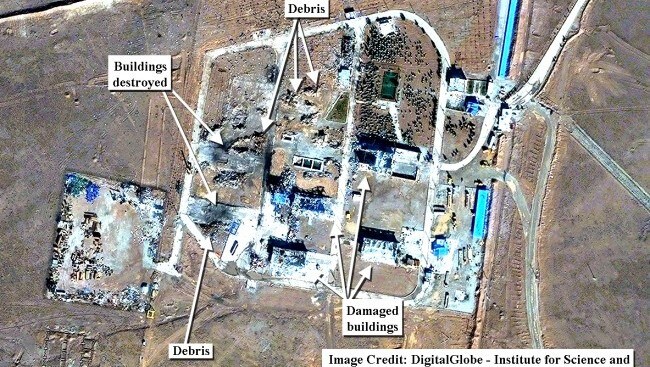
The latest attack on Iran's civilian nuclear program followed a blast two weeks ago at the sprawling Bid Ganeh missile base 25 miles west of Tehran.

That blast killed upwards of 30 members of the Iran Revolutionary Guard Corps (IRGC), including Major General Hassan Moqqadam, a senior leader of Iran's missile program.

Satellite imagery shows much of the base in ruins. The attack was described by Time Magazine as the work "of Israel's external intelligence service, Mossad."

In a backhanded confirmation that Monday's blast was the handiwork of Mossad and their terrorist proxies, the Mojahedin-e Khalq (MEK), Frenkel wrote that "Dan Meridor, the Israeli Intelligence Minister, said: 'There are countries who impose economic sanctions and there are countries who act in other ways in dealing with the Iranian nuclear threat'."

Frenkel reported that "Major-General Giora Eiland, Israel's former director of national security told Israel's army radio that the Isfahan blast was no accident. 'There aren't many coincidences, and when there are so many events there is probably some sort of guiding hand, though perhaps it's the hand of God'," Eiland said.

The Isfahan blast, as with other recent attacks, were allegedly in response to allegations made last month in a report filed by the International Atomic Energy Agency (IAEA) that Iran may be seeking to develop nuclear weapons.

However, while the "Agency continues to verify the non-diversion of declared nuclear material at the nuclear facilities," the ginned-up report relied on information provided by "Member states," presumably Israel and United States in the form of forged computer laptop documents and other "intelligence sources."

The Agency claims they were "unable to provide credible assurance about the absence of undeclared nuclear material and activities in Iran, and therefore to conclude that all nuclear material in Iran is in peaceful activities."

Black operations targeting the Islamic Republic aren't solely the province of America's "stationary aircraft carrier in the Middle East," Israel. As Seymour Hersh reported last spring in The New Yorker: "In the past six years, soldiers from the Joint Special Operations Force, working with Iranian intelligence assets, put in place cutting-edge surveillance techniques, according to two former intelligence officers."

In 2007, ABC News disclosed that "the CIA has received secret presidential approval to mount a covert 'black' operation to destabilize the Iranian government."

Unnamed sources told ABC News that President Bush signed a presidential finding "that puts into motion a CIA plan that reportedly includes a coordinated campaign of propaganda, disinformation and manipulation of Iran's currency and international financial transactions."

Congress has appropriated some $300 million for the CIA and the Pentagon's covert war.

In the intervening years, those programs have turned lethal. Widely applauded by "liberal" Democrats and "conservative" Republicans alike, these programs have continued, indeed expanded under Barack Obama's "progressive" Democratic administration.

Despite the fact that there "is also constant satellite coverage of major suspect areas in Iran," The New Yorker reported "that nothing significantly new had been learned to suggest that Iran is pursuing a nuclear weapon."

'Shadow War' Heating Up

Iran's intelligence services haven't been sitting idly by watching American, British, and Israeli terror operations.

On Sunday, Al Jazeera reported that the Iranian armed forces "brought down an unmanned US spy plane."

"Iran's military has downed an intruding RQ-170 American drone in eastern Iran," Iran's Arabic-language Al Alam state television network quoted an unnamed source as saying on Sunday."

"The semiofficial Fars news agency," Al Jazeera averred, said "that the plane is now in the possession of Iran's armed forces. The Fars news agency is close to the powerful Revolutionary Guard."

"Fars reported that the drone had been brought down through a combined effort by Iran's armed forces, air defence forces and its electronic warfare unit after the plane briefly violated the country's airspace at its eastern border."

An unnamed source, according to AFP, warned that Iran's armed response would "not be limited to our country's borders" for the "blatant territorial violation."

AFP also reported that in June, "Brigadier General Amir-Ali Hajizadeh, the commander of the Guards' aerospace unit, said Iran had shown Russian experts the US drones in its possession.

"'Russian experts requested to see these drones and they looked at both the downed drones and the models made by the Guards through reverse engineering,' he said."

In a further sign that the "shadow war" is heating up, last week's occupation of the British embassy in Tehran may have been a warning to the U.K. over sanctioned leaks by the British defense establishment to The Guardian which suggested that "Britain's armed forces are stepping up their contingency planning for potential military action against Iran."

"In anticipation of a potential attack," The Guardian disclosed that "British military planners are examining where best to deploy Royal Navy ships and submarines equipped with Tomahawk cruise missiles over the coming months as part of what would be an air and sea campaign.

The embassy occupation and subsequent downgrade of diplomatic relations between Britain and Iran mean these threats are being taken very seriously indeed.

Asia Times Online reported that Iran's claim "to have arrested 12 spies working for the United States Central Intelligence Agency (CIA) is potentially a major blow to American intelligence-gathering efforts in Iran and to American intelligence generally."

Following closely on the heels of last month's arrest in Lebanon of some 30 CIA operatives by Hezbollah "is suggestive of a major American intelligence defeat, if not a full-blown disaster," Asia Times analyst Mahan Abedin wrote.

Far from being a high-quality intelligence operation, Abedin averred that the "CIA is operating a lower threshold of quality control in terms of agent recruitment and management" and that this reflects "a scatter-gun approach by the CIA inasmuch as the agency is targeting virtually any Iranian citizen it believes could potentially provide useful information on the CIA's target set."

According to Abedin's Iranian sources, the CIA's team of "operatives and analysts" appears to have been "embedded within numerous official and unofficial American organizations, including US embassies, multinational corporations, medium-sized commercial organizations, recruitment consultancies, immigration and wider legal services, academic and quasi-academic institutions and reputable (i.e. longstanding) as well as newly set up think tanks."

In other words, as many researchers have amply documented, efforts by the U.S. secret state to subvert a target nation's internal defenses prior to full-on "regime change" either through direct warfare (Afghanistan, Iraq, Libya, now Syria) or via an American-brokered "color revolution" (Yugoslavia, Venezuela, Ukraine, Georgia) are not about "freedom and democracy" but to achieve Washington's geopolitical goals: total economic and political domination.

"But despite clear improvements in counter-espionage capabilities and protective security measures," Abedin writes, "Iran is still some way away from making it prohibitively costly for Western agencies to operate inside the country. Indeed, all the major West European, North American and Israeli intelligence services are either active inside Iran or work closely with some elements of the Iranian diaspora."

Describing the "psychological warfare" dimensions of a looming confrontation, Abedin wrote in a subsequent Asia Times Online piece that the covert war operates on two fronts, "one visible and rhetorical and conducted through official and unofficial media and the other secret and centered on sabotage."

"In so far as the former is concerned Iran has risen to the challenge by superseding tough American and Israeli rhetoric with even tougher rhetoric."

"However," Abedin averred, "it is on the sabotage front--where Iran appears to be under attack from several directions--that the Islamic Republic is raising eyebrows even amongst its hardcore supporters by displaying remarkable tolerance in the face of intolerable provocations."

"More broadly, the Iranians are not paying sufficient attention to the long-term consequences of military confrontation with the United States and her allies."

That the "long-term consequences" of a Western-led attack will be an unmitigated disaster for the Iranian people, indeed for people across the entire region and for world peace and stability as a whole, doesn't mean that Washington won't gamble that a "limited war" could be "contained."

As analyst William Blum wrote in his Anti-Empire Report: "The secret to understanding US foreign policy is that there is no secret. Principally, one must come to the realization that the United States strives to dominate the world. Once one understands that, much of the apparent confusion, contradiction, and ambiguity surrounding Washington's policies fades away."

"Examine a map," Blum observed. "Iran sits directly between two of the United States' great obsessions--Iraq and Afghanistan ... directly between two of the world's greatest oil regions--the Persian Gulf and Caspian Sea areas ... it's part of the encirclement of the two leading potential threats to American world domination--Russia and China ... Tehran will never be a client state or obedient poodle to Washington. How could any good, self-respecting Washington imperialist resist such a target? Bombs Away!"

Commenting on the Isfahan attack which described Israeli "black ops" as a "route to war," left-wing analyst Richard Silverstein wrote on the Tikun Olam web site, that "the tragedy of this black ops program is that it will not rattle or deter Iran, as Israeli intelligence believes."

"Contrary to what Israeli generals believe," Silverstein wrote, "the Iranians are not pushovers, they can't be intimidated. They're willing to die for their country even more than Israelis. They've fought defensive wars going back decades and lost millions in conflict. A few explosions, assassinations, and computer viruses will not spook them."

The drift towards war, which include moves to strangle Iran's economy prior to a strike, has gained traction on multiple fronts.

On Friday, the U.S. Senate unanimously passed legislation as part of the $644. 3 billion 2012 Defense Authorization Act that "would give the president the power starting July 1 to bar foreign financial institutions that do business with Iran's central bank from having correspondent bank accounts in the U.S.," Bloomberg BusinessWeek reported.

Coupled with reports that Germany and other EU member states will "considerably strengthen" sanctions against Iran, the leftist publication German Foreign Policy disclosed that "Berlin is participating in the intensification of western pressure on Teheran."

Rejecting NATO rhetoric that new punitive economic measures are over "the so-called nuclear dispute," GFP's analyst correctly states that the "conflict is, in fact, over hegemony, with the West seeking to defend at all costs its predominance in the Middle Eastern resource-rich regions."

While "Berlin's politicians are still divided over Iran ... Transatlantic oriented forces are preparing the public for possible military strikes."

Regarding the strengthening of the West's sanctions regime, the World Socialist Web Site reported that the EU has "agreed to sanction some 200 Iranian companies, individuals and organisations. European Council President Herman Van Rompuy met with Obama on Monday and issued a joint statement expressing 'deep concern' over Iran's nuclear program, raising the possibility of 'additional measures' against the Iranian regime."

"France," left-wing critic Oliver Campbell noted, "which is not a major importer of Iranian oil, issued a statement calling for 'new sanctions on an unprecedented scale,' including freezing the assets of the Iranian central bank and putting an embargo on Iranian oil."

"Russia, which has acquiesced in imposing previous sanctions on Iran, has bluntly opposed further punitive measures. Russian foreign ministry spokesman Alexander Lukashevich denounced the latest sanctions as 'unacceptable' and 'contradictory to international law.' China and Turkey have also opposed additional UN penalties."

There are new signs that this sharply escalating crisis is fraught with peril.

Last week, Russia Today reported that "Moscow is deploying warships at its base in the Syrian port of Tartus. The long-planned mission comes, providentially, at the very moment when it could help prevent a potential conflict in the strategically important Middle Eastern country.

­"The Russian battle group will consist of three vessels led by the heavy aircraft-carrying missile cruiser, Admiral Kuznetsov."

"Of course, the Russian naval forces in the Mediterranean will be incommensurate with those of the US 6th Fleet, which includes one or two aircraft carriers and several escort ships," former Chief of Naval Staff Admiral Viktor Kravchenko told Russia Today.

Pointedly, Kravchenko warned, "today, no one talks about possible military clashes, since an attack on any Russian ship would be regarded as a declaration of war with all the consequences."

Richard Silverstein grimly observed "that Israel knows that black ops will turn Iran more intransigent. It welcomes such Iranian rigidity because it means the day is closer when it will be set loose on the Iranians. Israel's policy toward Iran is scorched earth."

The clock is ticking...

Friday, November 25, 2011

Target Iran: Washington's Countdown to War


The Iranian people know what it means to earn the enmity of the global godfather.

As William Blum documented in Killing Hope: U.S. Military and CIA Interventions Since World War II, 1953's CIA-organized coup against Iranian Prime Minister Mohammed Mossadegh, guilty of the "crime" of nationalizing the Anglo-Iranian Oil Company, may have "saved" Iran from a nonexistent "Red Menace," but it left that oil-rich nation in proverbial "safe hands"--those of the brutal dictatorship of Mohammad Reza Shah Pahlavi.

Similarly today, a nonexistent "nuclear threat" is the pretext being used by Washington to install a "friendly" regime in Tehran and undercut geopolitical rivals China and Russia in the process, thereby "securing" the country's vast petrochemical wealth for American multinationals.

As the U.S. and Israel ramp-up covert operations against Iran, the Pentagon "has laid out its most explicit cyberwarfare policy to date, stating that if directed by the president, it will launch 'offensive cyber operations' in response to hostile acts," according to The Washington Post.

Citing "a long-overdue report to Congress released late Monday," we're informed that "hostile acts may include 'significant cyber attacks directed against the U.S. economy, government or military'," unnamed Defense Department officials stated.

However, Air Force General Robert Kehler, the commander of U.S. Strategic Command (USSTRATCOM) told Reuters, "I do not believe that we need new explicit authorities to conduct offensive operations of any kind."

The Pentagon report, which is still not publicly available, asserts: "We reserve the right to use all necessary means--diplomatic, informational, military and economic--to defend our nation, our allies, our partners and our interests."

Washington's "interests," which first and foremost include "securing its hegemony over the energy-rich regions of the Middle East and Central Asia" as the World Socialist Web Site observed, may lead the crisis-ridden U.S. Empire "to take another irresponsible gamble to shore up its interests in the Middle East ... as a means of diverting attention from the social devastation produced by its austerity agenda."

Recent media reports suggest however, that offensive cyber operations are only part of Washington's multipronged strategy to soften-up the Islamic Republic's defenses as a prelude to "regime change."

Terrorist Proxies

For the better part of six decades, terrorist proxies have done America's dirty work. Hardly relics of the Cold War past, U.S. and allied secret state agencies are using such forces to carry out attacks inside Iran today.

Asia Times Online reported that "deadly explosions at a military base about 60 kilometers southwest of Tehran, coinciding with the suspicious death of the son of a former commander of the Islamic Revolutionary Guards Corps (IRGC) in Dubai in the United Arab Emirates, have triggered speculation in Iran on whether or not these are connected to recent United States threats to resort to extrajudicial executions of IRGC leaders."

And Time Magazine, a frequent outlet for sanctioned leaks from the Pentagon, reported that the blast at the Iranian missile base west of Tehran, which killed upwards of 40 people according to the latest estimates, including Major General Hassan Moqqadam, a senior leader of Iran's missile program, was described as the work "of Israel's external intelligence service, Mossad."

An unnamed "Western intelligence source" told reporter Karl Vick: "'Don't believe the Iranians that it was an accident,' adding that other sabotage is being planned to impede the Iranian ability to develop and deliver a nuclear weapon. 'There are more bullets in the magazine,' the official says."

While Iranian officials insist that the huge blast was an "accident," multiple accounts in the corporate press and among independent analysts provide strong evidence for the claim that Israel and their terrorist cat's paw, the bizarre political cult, Mojahedin-e Khalq (MEK) were responsible for the attack.

Richard Silverstein, a left-wing analyst who writes for the Tikun Olam web site, said that the blast was a sign that "the face of the Israeli terror machine may have reared its ugly head in the world."

Citing "an Israeli source with extensive senior political and military experience," Silverstein's correspondent provided "an exclusive report that it was the work of the Mossad in collaboration with the MEK."

Hardly a stranger to controversial reporting, Silverstein published excerpts of secret FBI transcripts leaked to him by the heroic whistleblower Shamai Leibowitz. Those wiretapped conversations of Israeli diplomats caught spying on the U.S., "described an Israeli diplomatic campaign in this country to create a hostile environment for relations with Iran."

In a Truthout piece, Silverstein wrote that Leibowitz, a former IDF soldier who refused to serve in the Occupied Territories, "explained that he was convinced from his work on these recordings that the Israel foreign ministry and its officials in this country were responsible for a perception management campaign directed against Iran. He worried that such an effort might end with either Israel or the US attacking Iran and that this would be a disaster for both countries."

Unfortunately, while Leibowitz sits in a U.S. prison his warnings are all but ignored.

According to Silverstein's latest account, "it is widely known within intelligence circles that the Israelis use the MEK for varied acts of espionage and terror ranging from fraudulent Iranian memos alleging work on nuclear trigger devices to assassinations of nuclear scientists and bombings of sensitive military installations."

Silverstein noted that "a similar act of sabotage happened a little more than a year ago at another IRG missile base which killed nearly 20."

Terrorist attacks targeting defense installations coupled with the murder of Iranian scientist, five "targeted killings" have occurred since 2010, aren't the only aggressive actions underway.

On Friday, The Washington Post reported that "a series of mysterious incidents involving explosions at natural gas transport facilities, oil refineries and military bases ... have caused dozens of deaths and damage to key infrastructure in the past two years."

According to the Post, "suspicions have been raised in Iran by what industry experts say is a fivefold increase in explosions at refineries and gas pipelines since 2010."

With Iran's oil industry under a strict sanctions regime by the West, maintenance of this critical industrial sector has undoubtedly suffered neglect due to the lack of spare parts.

However, "suspicions that covert action might already be underway were raised when four key gas pipelines exploded simultaneously in different locations in Qom Province in April," the Post disclosed.

"Lawmaker Parviz Sorouri told the semiofficial Mehr News Agency that the blasts were the work of 'terrorists' and were 'organized by the enemies of the Islamic Republic'," hardly an exaggerated charge given present tensions.

Whether or not these attacks were the handiwork of Mossad, their MEK proxies or even CIA paramilitary officers and Pentagon Joint Special Operations Command (JSOC) commandos, as Seymour Hersh revealed more than three years ago in The New Yorker, it is clear that Washington and Tel Aviv are "preparing the battlespace" on multiple fronts.

'Collapse the Iranian Economy'

Along with covert operations and terrorist attacks inside the Islamic Republic, on the political front, a bipartisan consensus has clearly emerged in Washington in favor of strangling the Iranian economy.

Indeed, congressional grifters are threatening to crater Iran's Central Bank, an unvarnished act of war. IPS reported that neocon Senator Mark Kirk (R-IL), "a key pro-Israel senator," has offered legislation "that would effectively ban international financial companies that do business with the Central Bank of Iran (CBI) from participating in the U.S. economy."

"Dubbed the 'nuclear option' by its critics," Jim Lobe reported that "the measure, which was introduced Thursday in the form of an amendment to the 2012 defence authorisation bill, is designed to 'collapse the Iranian economy'... by making it virtually impossible for Tehran to sell its oil."

However, "independent experts," Lobe wrote, "including some officials in the administration of President Barack Obama, say the impact of such legislation, if it became law, could spark a major spike in global oil prices that would push Washington's allies in Europe even deeper into recession and destroy the dwindling chances for economic recovery here."

That amendment was introduced as tensions were brought to a boil over allegations by the International Atomic Energy Agency (IAEA) in its latest report that Iran may be seeking to develop nuclear weapons.

IAEA Director General Yukiya Amano claims the Agency has "identified outstanding issues related to possible military dimensions to Iran's nuclear programme and actions required of Iran to resolve these."

"Since 2002," Amano averred, "the Agency has become increasingly concerned about the possible existence in Iran of undisclosed nuclear related activities involving military related organizations, including activities related to the development of a nuclear payload for a missile, about which the Agency has regularly received new information."

However, despite the fact that the "Agency continues to verify the non-diversion of declared nuclear material at the nuclear facilities," to whit, that such materials have not been covertly channeled towards military programs, Amano, reprising former Defense Secretary Donald Rumsfeld's famous gaff that "the absence of evidence is not the evidence of absence," the IAEA "is unable to provide credible assurance about the absence of undeclared nuclear material and activities in Iran, and therefore to conclude that all nuclear material in Iran is in peaceful activities."

Far from being an independent "nuclear watchdog," the IAEA under Amano's stewardship has been transformed into highly-politicized and pliable organization eager to do Washington's bidding.

As a 2009 State Department cable released by WikiLeaks revealed, U.S. Ambassador Glyn Davies cheerily reported: "Yukiya Amano thanked the U.S. for having supported his candidacy and took pains to emphasize his support for U.S. strategic objectives for the Agency. Amano reminded Ambassador on several occasions that he would need to make concessions to the G-77, which correctly required him to be fair-minded and independent, but that he was solidly in the U.S. court on every key strategic decision, from high-level personnel appointments to the handling of Iran's alleged nuclear weapons program." (emphasis added)

Although the new report "offered little that was not already known by experts about Iran's nuclear programme" IPS averred, "it cited what it alleged was new evidence that 'Iran has carried out activities relevant to the development of a nuclear device' since 2003--the date when most analysts believe it abandoned a centralised effort to build a nuclear bomb'."

But as the United States, with the connivance of corporate media, bury the conclusions of not one, but two National Intelligence Estimates issued by the U.S. Director of National Intelligence, it is clear to any objective observer that "nonproliferation" is a cover for aggressive geopolitical machinations by Washington.

Both estimates, roundly denounced by U.S. neoconservatives and media commentators when they were published, insisted that "in fall of 2003, Tehran halted its nuclear weapons program," a finding intelligence analysts judged with "high confidence."

In contrast, the highly-politicized IAEA report is a provocative document whose timing neatly corresponds with the imposition of a new round of economic sanctions meant to crater the Iranian economy. Never mind that even according to the IAEA's own biased reporting, they could find no evidence that Iran had diverted nuclear materials from civilian programs (power generation, medical isotopes) to alleged military initiatives.

Indeed, with sinister allusions that hint darkly at "undeclared nuclear materials," the agency fails to provide a single scrap of evidence that diverted stockpiles even exist.

Another key allegation made by the Agency that Iran had constructed an "explosives chamber to test components of a nuclear weapon and carry out a simulated nuclear explosion," was denounced by former IAEA inspector Robert Kelley as "highly misleading," according to an IPS report filed by investigative journalist Gareth Porter.

With "information provided by Member States," presumably Israel and the United States, the IAEA said it "had 'confirmed' that a 'large cylindrical object' housed at the same complex had been 'designed to contain the detonation of up to 70 kilograms of high explosives'. That amount of explosives, it said, would be 'appropriate' for testing a detonation system to trigger a nuclear weapon."

"Kelley rejected the IAEA claim that the alleged cylindrical chamber was new evidence of an Iranian weapons programme," Porter wrote. "We've been led by the nose to believe that this container is important, when in fact it's not important at all," the former nuclear inspector said.

But as Mark Twain famously wrote, "A lie can travel half way around the world while the truth is putting on its shoes." This is certainly proving to be the case with the IAEA under Yukiya Amano.

Another player "solidly in the U.S. court" is David Albright, the director of the Institute for Science and International Security (ISIS), a Washington, D.C. "think tank" funded by the elitist Carnegie, Ford and Rockefeller Foundations.

In an earlier piece for IPS, Porter demolished Albright's "sensational claim previously reported by news media all over the world that a former Soviet nuclear weapons scientist had helped Iran construct a detonation system that could be used for a nuclear weapon."

"But it turns out that the foreign expert, who is not named in the IAEA report but was identified in news reports as Vyacheslav Danilenko, is not a nuclear weapons scientist but one of the top specialists in the world in the production of nanodiamonds by explosives," Porter wrote.

"In fact," Porter averred, "Danilenko, a Ukrainian, has worked solely on nanodiamonds from the beginning of his research career and is considered one of the pioneers in the development of nanodiamond technology, as published scientific papers confirm."

"It now appears that the IAEA and David Albright ... who was the source of the news reports about Danilenko, never bothered to check the accuracy of the original claim by an unnamed 'Member State' on which the IAEA based its assertion about his nuclear weapons background."

It is no small irony, that Albright, corporate media's go-to guy on all things nuclear, penned an alarmist screed in 2002 entitled, "Is the Activity at Al Qaim Related to Nuclear Efforts?", an article which lent "scientific" credence to false claims made by the Bush White House against Iraq.

As investigative journalist Robert Parry pointed out on the Consortium News web site, "Albright's nuclear warning about Iraq coincided with the start of the Bush administration's propaganda campaign to rally Congress and the American people to war with talk about 'the smoking gun in the form of a mushroom cloud'."

"Yet," Parry noted, "when the Washington Post cited Albright on Monday, as the key source of a front-page article about Iran's supposed progress toward reaching 'nuclear capability,' all the history of Albright's role in the Iraq fiasco disappeared."

History be damned. Congressional warmongers and corporate media who cite these fraudulent claims, are "spurred by Israel's whisper campaign to create a sense of urgency on Capitol Hill where the Israel lobby, acting mainly through the American Israel Public Affairs Committee, exerts its greatest influence," as IPS noted, and punish Iran for the "crime" of opening its nuclear facilities to international inspection!

That "whisper campaign" has now bloomed into a full court press for war by "liberal" Democrats and "conservative" Republicans alike, even as public approval of Congress's work by the American people tracks only slightly higher than the popularity enjoyed by child molesters or serial killers.

As tensions are dialed up, the United States is spearheading a relentless drive to throttle Iran's economy. The New York Times reported that "major Western powers took significant steps on Monday to cut Iran off from the international financial system, announcing coordinated sanctions aimed at its central bank and commercial banks."

A strict sanctions regime was also imposed on Iran's "petrochemical and oil industries, adding to existing measures that seek to weaken the Iranian government by depriving it of its ability to refine gasoline or invest in its petroleum industry," the Times reported.

In a move which signals that even-more stringent sanctions are on the horizon, the U.S. Treasury Department "named the Central Bank of Iran and the entire Iranian banking system as a 'primary money laundering concern'."

That's rather rich coming from an administration which slapped Wachovia Bank on the wrist after that corrupt financial institution, now owned by Wells Fargo Bank, pleaded guilty to laundering as much as $378 billion for Mexico's notorious drug cartels as Bloomberg Markets Magazine reported last year!

Going a step further, France's President Nicolas Sarkozy called on the major imperialist powers "to freeze the assets of the central bank and suspend purchases of Iranian oil."

The Guardian reported that Britain "went the furthest by, for the first time, cutting an entire country's banking system off from London's financial sector."

Playing catch-up with war-hungry Democrats and Republicans, President Obama stated that the "new sanctions target for the first time Iran's petrochemical sector, prohibiting the provision of goods, services and technology to this sector and authorizing penalties against any person or entity that engages in such activity."

"They expand energy sanctions, making it more difficult for Iran to operate, maintain, and modernize its oil and gas sector," Obama said.

"As long as Iran continues down this dangerous path, the United States will continue to find ways, both in concert with our partners and through our own actions, to isolate and increase the pressure upon the Iranian regime."

Last summer, Rep. Brad Sherman (D-CA), a strong backer of punishing sanctions, echoed Richard Nixon's vow to "make the economy scream" prior to the CIA's overthrow of Chile's democratically-elected socialist president, Salvador Allende, and wrote in The Hill that "critics ... argued that these measures will hurt the Iranian people. Quite frankly, we need to do just that."

With a new round of crippling economic sanctions on tap from the West, "liberal" Democrat Sherman might just get his wish.

Targeting Civilian Infrastructure

While the Obama administration claims that their aggressive stance towards Iran is meant to promote "peace" and "help" the Iranian people achieve a "democratic transformation," ubiquitous facts on the ground betray a far different, and uglier, reality.

Anonymous U.S. "intelligence officials" told The Daily Beast "that any Israeli attack on hardened nuclear sites in Iran would go far beyond airstrikes from F-15 and F-16 fighter planes and likely include electronic warfare against Iran's electric grid, Internet, cellphone network, and emergency frequencies for firemen and police officers."

According to Newsweek national security correspondent Eli Lake, "Israel has developed a weapon capable of mimicking a maintenance cellphone signal that commands a cell network to 'sleep,' effectively stopping transmissions, officials confirmed. The Israelis also have jammers capable of creating interference within Iran's emergency frequencies for first responders."

But Israel isn't the only nation capable of launching high-tech attacks or, borrowing the Pentagon's euphemistic language, conduct "Information Operations" (IO).

The U.S. Air Force Cyberspace & Information Operations Study Center (CIOSC) describe IO as "The integrated employment of the core capabilities of electronic warfare, computer network operations, psychological operations, military deception and operations security, in concert with specified supporting and related capabilities, to influence, disrupt, corrupt or usurp adversarial human and automated decision making while protecting our own."

In this light, The Daily Beast disclosed that "Israel also likely would exploit a vulnerability that U.S. officials detected two years ago in Iran's big-city electric grids, which are not 'air-gapped'--meaning they are connected to the Internet and therefore vulnerable to a Stuxnet-style cyberattack--officials say."

The anonymous officials cited by Lake informed us that "a highly secretive research lab attached to the U.S. joint staff and combatant commands, known as the Joint Warfare Analysis Center (JWAC), discovered the weakness in Iran's electrical grid in 2009," the same period when Stuxnet was launched, and that Israeli and Pentagon cyberwarriors "have the capability to bring a denial-of-service attack to nodes of Iran's command and control system that rely on the Internet."

But as Ralph Langer, the industrial controls systems expert who first identified the Stuxnet virus warned in an interview with The Christian Science Monitor, the deployment of military-grade malicious code is a "game changer" that has "opened Pandora's box."

Among a host of troubling questions posed by Stuxnet, Langer said: "It raises, for one, the question of how to apply cyberwar as a political decision. Is the US really willing to take down the power grid of another nation when that might mainly affect civilians?"

But as we have seen, most recently during the punishing air campaign that helped "liberate" Libya--from their petrochemical resources--the U.S. and their partners are capable of doing that and more.

Future targeting of Iran's civilian infrastructure may in fact have been one of the tasks of the recently-discovered Duqu Trojan, which Israeli and U.S. "boutique arms dealers" are suspected of designing for their respective governments.

And whom, pray tell, has the means, motives and expertise to design weaponized computer code?

As BusinessWeek disclosed in July, when one of America's cyber merchants of death, Endgame Systems, pitch their products they "bring up maps of airports, parliament buildings, and corporate offices. The executives then create a list of the computers running inside the facilities, including what software the computers run, and a menu of attacks that could work against those particular systems."

According to BusinessWeek, "Endgame weaponry comes customized by region--the Middle East, Russia, Latin America, and China--with manuals, testing software, and 'demo instructions'."

"A government or other entity," journalists Michael Riley and Ashlee Vance revealed, "could launch sophisticated attacks against just about any adversary anywhere in the world for a grand total of $6 million. Ease of use is a premium. It's cyber warfare in a box."

Kaspersky Lab analyst Ryan Naraine, writing on the Duqu FAQ blog averred that Duqu's "main purpose is to act as a backdoor into the system and facilitate the theft of private information. This is the main difference when compared to Stuxnet, which was created to conduct industrial sabotage."

In other words, unlike Stuxnet, Duqu is an espionage tool which can smooth the way for future attacks such as those described by The Daily Beast.

As The Washington Post disclosed last May, while the military "needs presidential authorization to penetrate a foreign computer network and leave a cyber-virus that can be activated later," it does not need such authorization "to penetrate foreign networks for a variety of other activities."

According to the Post, these activities include "studying the cyber-capabilities of adversaries or examining how power plants or other networks operate," and can "leave beacons to mark spots for later targeting by viruses."

Or more likely given escalating tensions, Iranian air defenses and that nation's power and electronic communications grid which include "emergency frequencies for firemen and police officers" who would respond to devastating air and missile attacks.

Countdown to War

We can conclude that Israel, NATO and the United States are doing far more than placing "all options on the table" with respect to the Islamic Republic of Iran.

Along with ratcheting-up bellicose rhetoric, moves to collapse the economy, an assassination and sabotage campaign targeting Iranian scientists and military installations, cyberwarriors are infecting computer networks with viruses and "beacons" that will be used to attack air defense systems and civilian infrastructure.

After all, as Dave Aitel, the founder of the computer security firm Immunity told BusinessWeek, "nothing says you've lost like a starving city."

As Global Research analyst Michel Chossudovsky warned last year, now confirmed by CIA and Pentagon leaks to corporate media: "It is highly unlikely that the bombings, if they were to be implemented, would be circumscribed to Iran's nuclear facilities as claimed by US-NATO official statements. What is more probable is an all out air attack on both military and civilian infrastructure, transport systems, factories, public buildings."

With the global economy in deep crisis as a result of capitalism's economic meltdown, and as the first, but certainly not the last political actions by the working class threaten the financial elite's stranglehold on power, the ruling class may very well gamble that a war with Iran is a risk worth taking.

As Chossudovsky warned in a subsequent Global Research report, "there are indications that Washington might envisage the option of an initial (US backed) attack by Israel rather than an outright US-led military operation directed against Iran."

"The Israeli attack--although led in close liaison with the Pentagon and NATO--would be presented to public opinion as a unilateral decision by Tel Aviv. It would then be used by Washington to justify, in the eyes of world opinion," Chossudovsky wrote, "a military intervention of the US and NATO with a view to 'defending Israel', rather than attacking Iran. Under existing military cooperation agreements, both the US and NATO would be 'obligated' to 'defend Israel' against Iran and Syria."

This prescient analysis has been borne out by events. As regional tensions escalate, the USS George H.W. Bush, "the Navy's newest aircraft carrier, has reportedly parked off the Syrian coast," The Daily Caller reported.

Earlier this week, the financial news service Zero Hedge disclosed that "the Arab League (with European and US support) are preparing to institute a no fly zone over Syria."

"But probably the most damning evidence that the 'western world' is about to do the unthinkable and invade Syria," analyst Tyler Durden wrote, "and in the process force Iran to retaliate, is the weekly naval update from Stratfor."

According to Zero Hedge, "CVN 77 George H.W. Bush has left its traditional theater of operations just off the Straits of Hormuz, a critical choke point, where it traditionally accompanies the Stennis, and has parked... right next to Syria."

In an earlier report, citing Kuwait's Al Rai daily, Zero Hedge warned that "Arab jet fighters, and possibly Turkish warplanes, backed by American logistic support will implement a no fly zone in Syria's skies, after the Arab League will issue a decision, under its Charter, calling for the protection of Syrian civilians."

The BBC reports that the Arab League "has warned Syria it has one day to sign a deal allowing the deployment of observers or it will face economic sanctions."

"Meanwhile," BBC averred, "France has suggested that some sort of humanitarian protection zones," à la Libya, "be created inside Syria."

American moves towards Syria are fraught with dangerous implications for international peace and stability. As analyst Pepe Escobar disclosed in Asia Times Online the Arab League, a wholly-owned subsidiary of Saudi Arabia and repressive Gulf emirates, dances to Washington's tune.

"Syria is Iran's undisputed key ally in the Arab world--while Russia, alongside China, are the key geopolitical allies. China, for the moment, is making it clear that any solution for Syria must be negotiated," Escobar wrote.

"Russia's one and only naval base in the Mediterranean is at the Syrian port of Tartus. Not by accident," Escobar notes, "Russia has installed its S-300 air defense system--one of the best all-altitude surface-to-air missile systems in the world, comparable to the American Patriot--in Tartus. The update to the even more sophisticated S-400 system is imminent."

"From Moscow's--as well as Tehran's--perspective, regime change in Damascus is a no-no. It will mean virtual expulsion of the Russian and Iranian navies from the Mediterranean."

"In other words," Zero Hedge warned, "if indeed Europe and the Western world is dead set upon an aerial campaign above Syria, then all eyes turn to the East, and specifically Russia and China, which have made it very clear they will not tolerate any intervention. And naturally the biggest unknown of all is Iran, which has said than any invasion of Syria will be dealt with swiftly and severely."

Despite, or possibly because no credible evidence exists that Iran is building a nuclear bomb as a hedge against "regime change," belligerent rhetoric and regional military moves targeting Syria and Iran simultaneously are danger signs that imperialism's manufactured "nuclear crisis" is a cynical pretext for war.

Sunday, November 13, 2011

Twitter Ordered to Hand Over WikiLeaks Info to Justice Department


In a further blow to online privacy rights and press freedom, the U.S. District Court in Alexandria, Va. ordered the microblogging site Twitter to hand over account information on three activists under investigation by the Justice Department for their links to the whistleblowing web site WikiLeaks.

Under "transparency president" Barack Obama, the U.S. government initiated a criminal probe of the organization after the site began releasing a virtual tsunami of confidential military and State Department files.

In the last two years alone, WikiLeaks revealed that the United States had committed grave war crimes in Afghanistan, Iraq and other global hot-spots of interest to America's resource-grabbing corporate masters.

This year's release of 779 classified dossiers on prisoners housed at the Guantánamo Bay prison gulag fleshed out the public's knowledge of ongoing torture programs run by the military and the CIA under cover of it's murderous "War on Terror."

But it was their publication of some 250,000 secret State Department cables which sparked a new round of hysterical denunciations in Washington culminating in the witchhunt against Julian Assange and WikiLeaks supporters, a demonization campaign aided and abetted by U.S. financial institutions such as Bank of America and Pentagon cyberwar contractors.

Cable after cable revealed "the extent of US spying on its allies and the UN; turning a blind eye to corruption and human rights abuse in 'client states'; backroom deals with supposedly neutral countries; lobbying for US corporations; and the measures US diplomats take to advance those who have access to them."

Leading politicians, including Vice President Joe Biden and Senate Minority leader Mitch McConnell have called the web site's founder a "high-tech terrorist," and commentators such as right-wing Washington Times columnist Jeffery Kuhner and others have demanded that Assange and his co-workers be treated "the same way as other high-value terrorist targets."

The Obama administration, loathe to pursue criminal probes of the previous regime's lawbreaking, the better to immunize themselves over their own contemporary lawless acts, including the torture of prisoners at Bagram Airbase, clandestine CIA drone killings and the due process-free assassination of an American citizen who was never charged, let alone convicted of a crime, was up to the challenge and empaneled a grand jury in Alexandria, Va.

And when Justice Department inquisitors first sought to seize the activist's information, in keeping with the new "Washington consensus" that constitutional rights are nothing more than empty platitudes duly trotted out on national holidays, they demanded that Twitter turn over the files without benefit of a warrant.

American Civil Liberties Union staff attorney Aden Fine denounced the ruling. "Internet users don't automatically give up their rights to privacy and free speech when they use services like Twitter," Fine said.

"The government shouldn't be able to get this kind of private information without a warrant, and they certainly shouldn't be able to do so in secret. An open court system is a fundamental part of our democracy, and the very existence of court documents should not be hidden from the public."

According to the ACLU, it wasn't only Twitter that was served with record demands by the Justice Department. "Based on the file numbers that have been created, it appears likely that there are additional orders whose existence remains secret."

The public first became aware of the government's fishing expedition only because Twitter informed the three activists, Jacob Appelbaum, a founding member of the online anonymity network, Tor Project, Rop Gonggrijp, a founder of the Dutch web portal XS4ALL and Birgitta Jónsdóttir, a left-wing member of Iceland's Parliament.

As Antifascist Calling reported in March, Jónsdóttir was specifically targeted for her role in helping WikiLeaks release the Collateral Murder video last year.

That scandalous video exposed the wanton slaughter of a dozen people in the Iraqi suburb of New Baghdad, including two Reuters photojournalists, by a U.S. military Apache helicopter crew. Two children were also seriously wounded in the unprovoked attack.

The Army's thrill-kill gun camera video wasn't concealed from the public because of any alleged threat to "national security" or to protect intelligence "sources and methods," standard boilerplate used to hide war crimes by the U.S. Empire, but precisely to cover-up imperialism's murderous rampage that helped "liberate" Iraqis of their lives.

Commenting on the ruling, Jónsdóttir told The Guardian, "This is a huge blow for everybody that uses social media. We have to have the same civil rights online as we have offline. Imagine if the US authorities wanted to do a house search at my home, go through my private papers. There would be a hell of a fight. It's absolutely unacceptable."

Unfortunately, under Section 213 of the oxymoronic USA Patriot Act, which was not subject to a "sunset" provision of the constitution-shredding legislation, FBI agents can do precisely that and obtain so-called "delayed notification" warrants for the search and seizure of evidence of any federal crime, not only those related to "terrorism" investigations.

Called "sneak and peek" searches, federal snoops are permitted to clandestinely seize property or conduct electronic searches on a home computer if a court deems such seizures "reasonably necessary." Indeed, notification of a covert FBI home invasion "may thereafter be extended by the court for good cause shown."

The sweeping ruling by Judge Liam O'Grady upheld demands by U.S. investigators that they should have virtual free-reign to pillage private records related to the users' IP address, the unique identifier used by a computer or hand-held device to log onto the internet.

According to the Electronic Frontier Foundation (EFF) who represent Jónsdóttir along with American Civil Liberties Union attorneys, O'Grady "also blocked the users' attempt to discover whether other Internet companies have been ordered to turn their data over to the government."

"When you use the Internet, you entrust your online conversations, thoughts, experiences, locations, photos, and more to dozens of companies who host or transfer your data," EFF Legal Director Cindy Cohn said.

"In light of that technological reality, we are gravely worried by the court's conclusion that records about you that are collected by Internet services like Twitter, Facebook, Skype and Google are fair game for warrantless searches by the government."

Among other things, O'Grady wrote in his 60-page decision that "the information sought was clearly material to establishing key facts related to an ongoing investigation and would have assisted a grand jury in conducting an inquiry into the particular matters under investigation."

O'Grady, appointed to the United States District Court for the Eastern District of Virginia in 2007 by President George W. Bush, argued that because Twitter users "voluntarily" turned over their IP addresses when they signed up for an account, they lost any expectation of privacy.

In other words, simply because users click through opaque "Terms of Service" agreements with Twitter, Google, Facebook or any other internet vendor, "petitioners knew or should have known that their I.P. information was subject to examination by Twitter, so they had a lessened expectation of privacy in that information, particularly in light of their apparent consent to the Twitter terms of service and privacy policy."

However, as security researcher Christopher Soghoian pointed out in Slight Paranoia, "The federal judge in the Wikileaks case cited in his order a version of Twitter's privacy policy from 2010, rather than the very different policy that existed when Appelbaum, Gonggrijp and Jonsdottir created their Twitter accounts back in 2008."

"That older policy," Soghoian wrote, "actually promised users that Twitter would keep their data private unless they violated the company's terms of service. It is unclear how the judge managed to miss this important detail."

"There is a slight problem with relying on a privacy policy created on November 16, 2010 to decide the reasonable expectation of privacy of these three individuals: They created their Twitter accounts several years before the document was written."

Indeed, as Soghoian observes, "not only is a federal judge ruling that 3 individuals have no reasonable expectation of privacy with regard to the government getting some of their Internet transaction data, but the judge isn't even citing the right version of a widely ignored privacy policy to do so."

"If the judge were to examine the privacy policy that existed when these three targets signed up for a Twitter account," Soghoian concludes, "he might decide that they do in fact have a reasonable expectation of privacy and that the government needs a warrant to get the data."

While true as far as it goes, and Soghoian should be commended for pointing out this glaring contradiction in the government's case, readers are well aware that the WikiLeaks Twitter case is about politics not process, that is, moves by the secret state to clamp-down on dissent and dissenters, and not whether someone has read and "voluntarily" signed-off on a vendor's "Terms of Service" agreement.

Among other things, O'Grady's ruling revealed that the government was seeking not only IP addresses but "1. subscriber names, user names, screen names, or other identities; 2. mailing addresses, residential addresses, business addresses, e-mail addresses and other contact information; 3. connection records, or records of session times and durations; 4. length of service (including start date) and types of service utilized; 5. telephone or instrument number or other subscriber number or identity, including any temporarily assigned network address; and 6. means and source of payment for such service (including any credit card or bank account number) and billing records."

It doesn't take a computer forensics expert to conclude that the government, in obtaining "connection records," will also get their hands on information about anyone else who corresponded or "followed" the activists on Twitter.

Kevin Bankston, a senior staff attorney with EFF told CNET News that the ruling means that "essentially any data about you collected by an Internet service is fair game for warrantless searches by the government."

The District Court's ruling can be situated within the wider context of the Obama administration's unprecedented drive to criminalize whistleblowing.

The persecution of Julian Assange and other WikiLeaks supporters is a shot across the bow not only against those who leak sensitive information to the public that expose egregious acts by the well-connected, but at investigative journalists and researchers who in their course of their work uncover high crimes and misdemeanors by powerful corporations and governments.

As the World Socialist Web Site pointed out, "Assange's real 'crime' is that, through its publication of a mass of secret US military documents, diplomatic cables and video footage, WikiLeaks has exposed the criminal character of the invasions and occupations of Afghanistan and Iraq and numerous other conspiracies carried out against the world's people by Washington and its allies."

Make no mistake, this ruling is a warning of further draconian moves to come.

Sunday, November 6, 2011

A Precursor to War? As Washington Renews Military Threats Against Iran, Cyber Attacks Escalate


As evidence mounts that the U.S. secret state is launching cyber weapons against official enemies, while carrying out wide-ranging spy ops against their "friends," Gen. Keith Alexander, the dual-hatted overlord of the National Security Agency and U.S. Cyber Command, says that the Obama administration is "working on a system" that will "help" ISPs thwart malicious attacks.

Speaking at the Security Innovation Network (SINET) "Showcase 2011" shindig at the National Press Club in Washington, Alexander told security grifters eager to gouge taxpayers for another piece of lucrative "cybersecurity" pie: "What I'm concerned about are the destructive attacks. Those are the things yet to come that cause us a lot of concern."

That's rather rich coming from the head of a secretive Pentagon satrapy suspected of designing and launching the destructive Stuxnet virus which targeted Iran's civilian nuclear program.

According to fresh evidence provided by IT security experts it now appears that the same constellation of shadowy forces which unleashed Stuxnet are at it again with the newly discovered Duqu spy Trojan.

In a follow-up analysis, Kaspersky Lab researcher Alex Gostev wrote that "the highest number of Duqu incidents have been recorded in Iran. This fact brings us back to the Stuxnet story and raises a number of issues."

Not least of which is the continuing demonization of the Islamic Republic by an unholy alliance of U.S. militarists, their Israeli pit bulls and congressional shills hyping the "Iran threat."

War Drums Beating

With the United States and the other capitalist powers incapable of digging the world economy out from under the slow-motion meltdown sparked by 2008's market collapse, and with tens of millions of enraged citizens rejecting austerity measures that will further enrich financial elites at their expense, will the Obama administration "go for broke" and set-off a new conflagration in the Middle East?

Ratcheting up bellicose rhetoric, John Keane, a retired four-star general, former Vice Chief of Staff of the U.S. Army now currently perched on the board of General Dynamics, a major purveyor of cyber attack tools for the government, told the House Homeland Security Committee October 26, "We've got to put our hand around their throat now. Why don't we kill them? We kill other people who are running terrorist operations against the United States."

AFP reported that "Iran made a formal protest" over Keane's remarks which urged "the targeted assassination of members of its elite Quds Force military special operations unit," over a fairy-tale plot allegedly cooked-up by Tehran, which employed a failed used-car salesman, a DEA snitch and members of the Zetas drug gang in a scheme to assassinate the Saudi ambassador in Washington.

While the plot lines are as preposterous as allegations prior to the 2003 Iraq invasion that Saddam Hussein's regime was involved in the 9/11 attacks, one cannot so easily dismiss the propaganda value of such reports by administration "information warriors." The same can be said of the series of controlled leaks emanating from London, Tel Aviv and Washington urging immediate air strikes against Iran's nuclear facilities.

The Guardian reported that "Britain's armed forces are stepping up their contingency planning for potential military action against Iran amid mounting concern about Tehran's nuclear enrichment programme."

Chillingly, the "Ministry of Defence believes the US may decide to fast-forward plans for targeted missile strikes at some key Iranian facilities. British officials say that if Washington presses ahead it will seek, and receive, UK military help for any mission, despite some deep reservations within the coalition government."

On the same day that MoD's sanctioned leak appeared in the British press, Haaretz disclosed that "Prime Minister Benjamin Netanyahu and Defense Minister Ehud Barak are trying to muster a majority in the cabinet in favor of military action against Iran, a senior Israeli official has said. According to the official, there is a 'small advantage' in the cabinet for the opponents of such an attack."

"Strategic Affairs Minister Moshe Ya'alon said he preferred an American military attack on Iran to an Israeli one. 'A military move is the last resort,' he said."

The Associated Press reported that as Netanyahu moved to persuade his cabinet to "authorize a military strike against Iran's suspected nuclear weapons program," Israel successfully test-fired "a missile believed capable of carrying a nuclear warhead to Iran."

Adding to the disinformational witch's brew, The Washington Post reported that "a new spike in anti-Iran rhetoric and military threats by Western powers is being fueled by fears that Iran is edging closer to the nuclear 'breakout' point, when it acquires all the skills and parts needed to quickly build an atomic bomb if it chooses to," anonymous "Western diplomats and nuclear experts said Friday."

Post stenographer Joby Warrick informed us that a "Western diplomat who had seen drafts of the report" told him "it will elaborate on secret intelligence collected since 2004 showing Iranian scientists struggling to overcome technical hurdles in designing and building nuclear warheads."

And late last week Reuters disclosed that "a senior U.S. military official said on Friday Iran had become the biggest threat to the United States and Israel's president said the military option to stop the Islamic republic from obtaining nuclear weapons was nearer."

"'The biggest threat to the United States and to our interests and to our friends ... has come into focus and it's Iran,' said the U.S. military official, addressing a forum in Washington." Conveniently, "reporters were allowed to cover the event on condition the official not be identified."

While some critics argue that Israel does not presently have the capacity to launch such an attack, and that "the volume of the war hysteria is being turned up with one purpose in mind: the Israelis want the US to do their dirty work for them," such reasoning is hardly reassuring.

Indeed, as the World Socialist Web Site points out, "the Israeli government has already made advanced preparations for an attack on Iran."

"On the military front," analyst Peter Symonds warned that "Israeli warplanes last week conducted a long-range exercise--of the type required to reach Iran--using a NATO airbase on the Italian island of Sardinia." In other words, the IDF drill was not a "rogue" exercise unilaterally conducted by Israel, but further evidence of Washington's "desperate bid to offset its economic decline by securing its hegemony over the energy-rich regions of the Middle East and Central Asia."

In the context of escalating tensions over Iran's nuclear enrichment program, seeded by manufactured "terror" plots, the imperialist powers may choose the "cyber" route prior to launching devastating missile and bomber strikes against Iranian military installations and civilian infrastructure.

Pentagon planners now believe that attack tools have reached the point where blinding Iran's air defenses while sowing chaos across population centers with power outages and the shutdown of financial services may now be a viable option.

This is not idle speculation. During the run-up to the 2003 Iraq invasion, the National Journal disclosed that Central Command "considered a computerized attack to disable the networks that controlled Iraq's banking system, but they backed off when they realized that those networks were global and connected to banks in France."

Facing growing opposition at home and abroad to endless wars and imperial adventures, would the Obama administration have such qualms today?

Attack Tools Already in Play

As Antifascist Calling previously reported, when the Duqu virus was discovered last month, analysts at Symantec believed that the remote access Trojan (RAT) "is essentially the precursor to a future Stuxnet-like attack."

"The threat was written by the same authors (or those who have access to the Stuxnet source code) and appears to have been created since the last Stuxnet file was recovered," researchers averred.

Since their initial reporting, Symantec, drawing on research from CrySyS lab at the Budapest University of Technology and Economics in Hungary, the organization which discovered the malware, reported they located an installer file in the form of a Microsoft Word document which exploits a previously unknown zero-day vulnerability.

Like Stuxnet, Duqu's stealthiness is directly proportional to its uncanny ability to capitalize on what are called zero-day exploits hardwired into it's digital DNA; security holes that are unknown to everyone until the instant they're used in an attack.

Similar to other dubious commodities traded on our dystopian "free markets," zero-days are bits of tainted code sought by criminal hackers, financial and industrial spies and enterprising security agencies that can sell for up to $250,000 a pop on the black market.

When Stuxnet appeared in dozens of countries last year, targeting what are called programmable logic controllers (PLCs) on industrial computers manufactured by Siemens that control everything from water purification and food processing to oil refining and potentially deadly chemical processes, researchers found it was designed to harm only one specific target: PLCs processing uranium fuel at a nuclear facility in Iran.

As Wired Magazine reported, when Symantec analysts who had been picking Stuxnet apart convinced internet service providers who controlled "servers in Malaysia and Denmark" where the virus "phoned home" each time it infected a new machine, to reroute the virus to a secure "sinkhole," they were in for a shock.

"Out of the initial 38,000 infections," journalist Kim Zetter wrote, "about 22,000 were in Iran. Indonesia was a distant second, with about 6,700 infections, followed by India with about 3,700 infections. The United States had fewer than 400. Only a small number of machines had Siemens Step 7 software installed--just 217 machines reporting in from Iran and 16 in the United States."

"The sophistication of the code," Wired averred, "plus the fraudulent certificates, and now Iran at the center of the fallout made it look like Stuxnet could be the work of a government cyberarmy--maybe even a United States cyberarmy.

"This made Symantec's sinkhole an audacious move," Zetter wrote. "In intercepting data the attackers were expecting to receive, the researchers risked tampering with a covert U.S. government operation."

Writing in the Journal of Strategic Studies, Thomas Rid, a former RAND Corporation employee and "Reader in War Studies at Kings College in London," who has close ties to the Western military establishment, observed in relation to Stuxnet that network "sabotage, first, is a deliberate attempt to weaken or destroy an economic or military system. All sabotage is predominantly technical in nature, but of course may use social enablers."

"The resources and investment that went into Stuxnet could only be mustered by a 'cyber superpower', argued Ralph Langner, a German control system security consultant who first extracted and decompiled the attack code."

In an interview with National Public Radio, Langer said that the "level of expertise" behind Stuxnet "seemed almost alien. But that would be science fiction, and Stuxnet was a reality."

"Thinking about it for another minute, if it's not aliens, it's got to be the United States."

"For the time being it remains unclear how successful the Stuxnet attack against Iran's nuclear program actually was" Rid noted. "But it is clear that the operation has taken computer sabotage to an entirely new level."

Researcher Vikram Thakur, commenting on the latest Duqu discoveries reported: "The Word document was crafted in such a way as to definitively target the intended receiving organization." And whom, pray tell, was being targeted by Duqu? Why Iran, of course.

"Once Duqu is able to get a foothold in an organization through the zero-day exploit, the attackers can command it to spread to other computers."

Thakur wrote, "the Duqu configuration files on these computers," which did not have the ability to connect to the internet and the author's command and control (C&C) server, "were instead configured not to communicate directly with the C&C server, but to use a file-sharing C&C protocol with another compromised computer that had the ability to connect to the C&C server."

"Consequently," Thakur concluded, "Duqu creates a bridge between the network's internal servers and the C&C server. This allowed the attackers to access Duqu infections in secure zones with the help of computers outside the secure zone being used as proxies."

As Kaspersky Lab researchers pointed out, "in each of the four instances of Duqu infection a unique modification of the driver necessary for infection was used."

"More importantly," analysts averred, "regarding one of the Iranian infections there were also found to have been two network attack attempts exploiting the MS08-067 [MS Word] vulnerability. This vulnerability was used by Stuxnet too."

"If there had been just one such attempt, it could have been written off as typical Kido activity--but there were two consecutive attack attempts: this detail would suggest a targeted attack on an object in Iran." (emphasis added)

Simply put, before the Pentagon decides to "kill them" as Gen. Keane indelicately put it, battlefield preparations via directed cyber attacks and other forms of sabotage may be part of a preemptive strategy to decapitate Iranian defenses prior to more "kinetic" attacks.

'Boutique Arms Dealers'

Despite media hype about future cuts in the so-called "defense" budget, Defense Industry Daily disclosed that "the US military has announced plans to spend billions on technology to secure its networks."

According to the Defense Department's FY 2012 budget proposal, "the Pentagon said it plans to spend $2.3 billion on cybersecurity capabilities."

However, when NextGov "questioned why the Air Force's $4.6 billion 2012 budget request for cybersecurity was $2.3 billion more than Defense's servicewide spending proposal, Pentagon officials upped their total figure from $2.3 billion to $3.2 billion."

Why the discrepancy? A "Pentagon spokesperson explained that the service's estimate differed dramatically because the Air Force included 'things' that are not typically considered information assurance or cybersecurity."

What kind of "things" are we talking about here?

As BusinessWeek reported in July, firms such as Northrop Grumman, Raytheon, and General Dynamics, "the stalwarts of the traditional defense industry," are "helping the U.S. government develop a capacity to snoop on or disable other countries' computer networks."

Capitalizing on the Defense Department's desire to develop "hacker tools specifically as a means of conducting warfare," this "shift in defense policy gave rise to a flood of boutique arms dealers that trade in offensive cyber weapons."

Investigative journalists Mike Riley and Ashlee Vance averred that "most of these are 'black' companies that camouflage their government funding and work on classified projects."

As last winter's hack of HBGary Federal by Anonymous revealed, "black" firms, including those like Palantir which received millions of dollars in start-up funding from the CIA's venture capital arm In-Q-Tel, hacker tools, such as sophisticated Trojans and stealthy rootkits, believed to be the route used to introduce the Stuxnet virus, have also been used to target political activists and journalists in the United States at the behest of financial institutions such as the Bank of America and the right-wing U.S. Chamber of Commerce.

As researcher Barrett Brown revealed, "Team Themis was a consortium made up of HBGary, Palantir, and Berico (with Endgame Systems serving as a 'silent partner' and providing assistance from the sidelines) that was set up in order to provide offensive intelligence capabilities to private clients."

Although Endgame Systems "went dark" after Anonymous released thousands of HBGary files, The Register disclosed that the firm "helps US intelligence identify and hack into vulnerable networks, and is targeting a similar role in Britain's nascent national cyber security operations."

The Register noted that the "limited publicly information currently available on the firm hints at its further role assisting clandestine government cyber operations by identifying targets and developing exploits."

As BusinessWeek revealed, the firm is "a major supplier of digital weaponry for the Pentagon. It offers a smorgasbord of wares, from vulnerability assessments to customized attack technology, for a dizzying array of targets in any region of the world."

Unsurprisingly, this was a major draw for venture capital firms "Bessemer Venture Partners and Kleiner Perkins Caufield & Byers," who collectively fronted Endgame some $30 million. According to Riley and Vance, "what really whet the VCs' appetites, though, according to people close to the investors, is Endgame's shot at becoming the premier cyber-arms dealer."

While a client list has yet to emerge, it's safe to assume that secret state agencies on both sides of the Atlantic are lining up to purchase Endgame's toxic products.

Although no definitive answer has emerged as to whom might targeting Iran with Duqu, as BusinessWeek revealed Endgame "deals in zero-day exploits. Some of Endgame’s technology is developed in-house; some of it is acquired from the hacker underground. Either way, these zero days are militarized--they've undergone extensive testing and are nearly fail-safe."

"People who have seen the company pitch its technology--and who asked not to be named because the presentations were private--say Endgame executives will bring up maps of airports, parliament buildings, and corporate offices."

According to Riley and Vance, "the executives then create a list of the computers running inside the facilities, including what software the computers run, and a menu of attacks that could work against those particular systems."

Indeed, "Endgame weaponry comes customized by region--the Middle East, Russia, Latin America, and China--with manuals, testing software, and 'demo instructions.' There are even target packs for democratic countries in Europe and other U.S. allies."

"The quest in Washington, Silicon Valley, and around the globe is to develop digital tools both for spying and destroying," BusinessWeek observed. "The most enticing targets in this war are civilian--electrical grids, food distribution systems, any essential infrastructure that runs on computers."

"This stuff is more kinetic than nuclear weapons," Dave Aitel, the founder of a computer security company in Miami Beach called Immunity told Riley and Vance. "Nothing says you've lost like a starving city."

While Aitel and a host of other "little Eichmanns" who enrich themselves servicing the American secret state refused to discuss his firm's work for the government, a source told the publication that Immunity "makes weaponized 'rootkits': military-grade hacking systems used to bore into other countries' networks," and that Aitel's clients "include the U.S. military and intelligence agencies."

We do not know if, or when, the United States, NATO and Israel will opt for a military "solution" to the so-called "Iranian problem."

We do know however, as the World Socialist Web Site warned, "as global capitalism lurches from one economic and political crisis to the next, rivalry between the major powers for markets, resources and strategic advantage is plunging humanity towards a catastrophic conflict that would devastate the planet."